Interwell Health CEO on Leading with Clarity and Bringing Care Closer to the Patient
Interwell Health CEO Tommy O’Connor shares his perspective on staying focused on what matters most, what sets Interwell apart in kidney care, and building a better patient experience.
tags
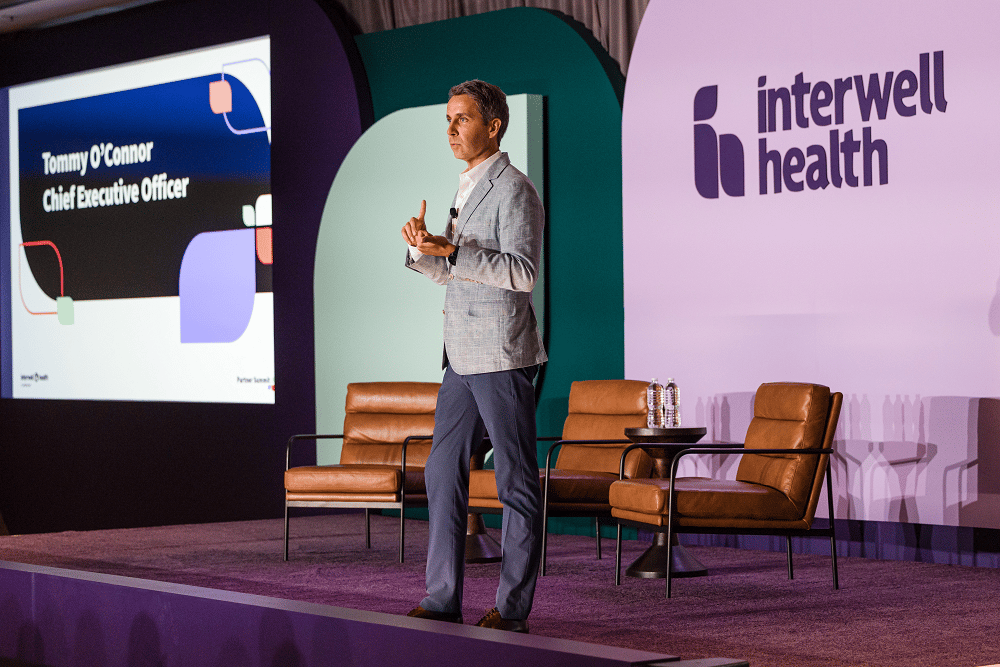
Tommy O’Connor has spent his career advancing patient-centered, value-based partnerships that improve how care is delivered. Before joining Interwell Health as CEO, he held leadership roles at UnitedHealth Group, where he was responsible for improving Medicare member health and satisfaction—experience that now shapes his approach to value-based kidney care.
Following a strong first half of 2026, O’Connor is focused on continuing to drive better outcomes, strengthening organizational capabilities, and improving the patient journey.
On why this work matters
Q: Coming from your previous healthcare leadership experience, what has reinforced for you that Interwell Health is solving the right problem?
TOC: My philosophy is simple: focus on quality, and the rest will follow. I’m incredibly proud of our consistent leadership in quality outcomes. Regardless of the financial model or geographic region, our relentless focus on quality ensures our patients receive best-in-class care from Interwell, our network providers, and Fresenius Medical Care (FME). That foundation will help us navigate change as our industry evolves.
Kidney care is one of the most significant and under-addressed challenges in healthcare today, and that’s exactly what makes Interwell’s work so important. At the core, what we do is about excellent patient care augmented by the best data and tools available. Nobody does that better in the kidney care space than Interwell Health.
Q: What is one experience or anecdote that stands out to you as exemplary of our mission and what makes Interwell unique?
TOC: A few months ago, while I was waiting for my car to be serviced, I started talking with one of the service agents. As it turned out, he is also one of our patients.
I learned from our conversation that he has later-stage chronic kidney disease, and he’d watched many family members suffer from CKD and related illnesses over his lifetime. “Not me,” he told me. “I need to make some changes.” With support from his Interwell network nephrologist and our registered dietitians, he changed his diet and lifestyle, significantly improving his kidney function and helping him lose more than 50 pounds.
He recently visited his fiancée in Miami after a few months apart. “She couldn’t take her eyes off of me!” he said, smiling. “I feel like a new man, ready for the rest of my life.”
We have all sorts of industry clinical trials and large-scale analyses, but all it takes is this “n of 1” for me to realize the work we do every day truly matters. Our work truly transforms patients’ lives.
On what makes Interwell different
Q: From your time at Interwell so far, what stands out most about Interwell’s approach?
TOC: Our talent and culture shine brightly. I’ve watched Interwell leaders and team members consistently demonstrate mastery in their domains. That’s refreshing, and it’s an encouraging sign that we’re really good at what we do.
I’ve also seen our organization operate very flat when we need to: getting to a root cause quickly, brainstorming solutions that touch multiple parts of the organization, and moving fast to meet acute patient care needs. That healthy blend has created a culture where teams collaborate and aren’t afraid to disagree. Healthy debate gets us to the right outcomes.
When you put compassion, collaboration, and humility first, you create an environment where people keep learning, growing, and getting better. We are constantly refining and evolving how we work, but the why never changes: everything we do is in service of our patients.
“We are constantly refining and evolving how we work, but the why never changes: everything we do is in service of our patients.”
Q: As Interwell continues to grow, what role do you see the company playing in the broader evolution of kidney care?
TOC: Until recently, patients sought care where the system was “at”: physical buildings, hospitals, eight-to-five appointments scheduled Monday through Friday, often months away. But care is evolving to mean what happens between conventional care visits. We now value the avoidance of certain services, like ER visits and unnecessary testing, on equal footing with the delivery of others.
That paradigm is shifting radically, and the lesson is clear: we need to meet patients earlier in their care journey, in their homes, and at odd hours when they’re turning to AI and chatbots to make sense of their health concerns. If we don’t meet patients where they are, someone else will.
On where we’re headed together
Q: What do you want your colleagues to understand about where we’re going?
TOC: We’re in the early stages of an important organizational stretch that will define our next chapter.
On one hand, we’re bringing our organization closer to the local market by strengthening our partnerships with network providers. In close collaboration with the FME Care Delivery, Care Enablement, and Global Medical Office teams, Interwell plays a key part in extending FME’s leadership at the market level. For many patients, Interwell is their first real connection to both FME and kidney care, often before they ever enter a clinic. That gives us a real opportunity to get that first impression right, build trust early, and set the tone for a relationship that may last years.
In the other direction, we’re stretching our capabilities up and out to impact renal care in a much broader sense. That means growing our physical footprint, innovating our care model, enhancing our technical capabilities through AI, and adopting an enterprise mindset to strengthen FME. Everyone has a role to play. Whether you’re embedded in a partner practice, building our next predictive model, or shaping the payer and provider partnerships that power our growth, your work helps us reach in both directions at once.
Q: What do you think our team should feel most proud of as we enter the second half of 2026?
TOC: Organizational change is difficult. I appreciate that aspects of our organization today look different than they did at the end of 2025.
Our team should be really proud that we’ve reinforced the areas where we’re already strong, and that we’ve spoken openly about our blind spots. That self-reflection has made us a stronger, more resilient company, ready for the future.
We still have a long way to go in 2026, and I’m counting on our talented teams to deliver on our organizational commitments. I have no doubt we will.
Q: Anything else you’d like to share?
TOC: Our industry is unique in that kidney care patients can be patients for years, even for life. That’s far different from hospitals, rehab services, and other segments of the care delivery system.
So going forward, we need to think about the patient experience not just as a clinical journey, but as a lifelong customer journey. What makes patients recommend us to a friend or family member? What would make them want to leave? What breadcrumbs can we follow upstream—clinical flags or genomic markers—to understand how patients progress and engage them earlier in their care journey?
If we get that right, we won’t just be reimagining kidney care. We’ll be redefining what it means to care for someone over a lifetime.